Fetal rhabdomyoma with maternal tuberous sclerosis that almost completely filled the left ventricle at an early gestational week
Fetal rhabdomyoma with maternal tuberous sclerosis that almost completely filled the left ventricle at an early gestational week
Eser Çolak 1,, Emel Ebru Özçimen 1, Zeynel Gökmen 2, Mahmut Gökdemir 3
Dear Editor,
Tuberous sclerosis complex (TSC) is an autosomal dominant neurocutaneous disease that shows different phenotypic properties even in the same family members. Its incidence is 1/6,000 to 1/10,000 in live births (1). Noncancerous tumors are formed in some tissues, such as the brain, skin, kidneys, eyes, and heart. It affects both maternal and fetal outcomes.
Frequently, the prenatal diagnosis of TSC is made on the detection of multiple cardiac rhabdomyomas by fetal ultrasound in the second or third trimester of pregnancy. It is reported that cardiac tumors are detected at the 15th week of pregnancy at earliest (2). Cardiac rhabdomyomas usually regress without treatment. However, close and frequent follow-up is required in terms of heart dysfunction in the intrauterine period or in the first six months after birth. In this case report, we discuss the management of a fetus with cardiac rhabdomyoma with almost the entire left ventricle filled in the early weeks of pregnancy.
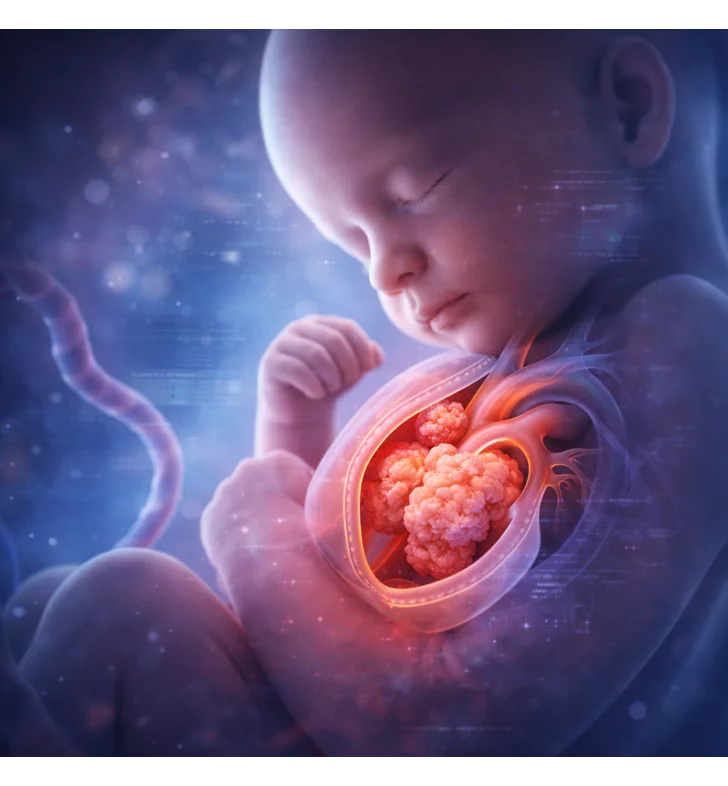
The mother, who was 30 years old and had three living children, applied to the Gynecology and Obstetrics Clinic in the 25th week of her fourth pregnancy. In the anamnesis, it was learned that the mother had tuberous sclerosis disease and that the third child was diagnosed with tuberous sclerosis and antiepileptic treatment was initiated. Fetal ultrasound revealed a fetus compatible with the 25th week of gestation. Amniotic fluid volume was normal. In the fetal heart examination, a mass with a long axis of 13 mm and a short axis of 10 mm owing to the intraventricular septum was observed in the left ventricle. No other extracardiac ultrasonography findings were detected. The family was informed according to the opinion of the pediatric cardiology department. Masses with multiple hyperechogenic solid boundaries in the myocardium were determined by fetal echocardiography at the 27th week of gestation. Myocardial function was normal. Pericardial effusion, valve insufficiencies, and hydrops fetalis symptoms were not determined. The mass with a long axis diameter of 13 mm in the left ventricle in the previous examination was now detected as 21 mm.In the 29th week of gestation, the mass had a long axis diameter of 31 mm, filling almost 90% of the left ventricular cavity, and everolimus (a mammalian target of rapamycin [mTOR] inhibitor) treatment was recommended based on the decision of the Gynecological and Pediatric Cardiology Council (3). To avoid any postnatal lung problems, because the family rejected the treatment, close follow-up and betamethasone treatment were applied. One course of betamethasone treatment was given one week before the planned delivery date in two doses with 24 hour intervals. In the 32nd gestational week, a live baby boy weighing 1,800 g was delivered. Cord blood was taken during birth for genetic analysis.
The infant was followed up in with the continuous positive airway pressure– and? nasal intermittent positive pressure ventilation mode in the neonatal intensive care unit. His first and fifth minute Apgar scores were 7 and 8, respectively.
On postnatal day 1, in addition to normal morphological cardiac anatomy in transthoracic echocardiography, multiple hyperechogenic solid borders in the myocardium were determined. Myocardial function was normal. The biggest of the masses, in the left ventricle, adjacent to the interventricular septum and filling almost 90% of the left ventricular cavity, had a long axis diameter of 31 mm and a short axis diameter of 18 mm. Despite narrowing of the left ventricular outflow to approximately 50%, no signs of stenosis were observed in the Doppler Echocardiographic examination. Mitral valve function was observed as normal, and normal sinus rhythm was determined on electrocardiogram. No surgical treatment was planned because the infant was asymptomatic, and antiarrhythmic and antiaggregant treatment was initiated.
Cranial MRI on postnatal day 10 showed that lesions compatible with cortical tubers and subependymal hamartoma were present in both cerebral hemispheres. The infant was discharged on the 12th day.
At postnatal month 2, the long axis diameter of the mass was 27 mm in transthoracic echocardiography, and there was a minimal regression. Ventricular contraction and inlet-outlet flows were normal, and arrhythmia was not detected. Therefore, no surgical or mTOR inhibitory therapy was planned. The asymptomatic infant was followed up for mass regression with antiaggregant and antiarrhythmic therapy. The results of the genetic analysis confirmed the diagnosis of tuberous sclerosis.
Fetal cardiac rhabdomyomas are the most common cardiac tumors associated with tuberous sclerosis (4). Management of cases in the intrauterine or postnatal period varies according to the presence of symptoms such as hydrops fetalis, obstruction of ventricular outflow tracts, arrhythmias, cardiac shock, and sudden infant deaths. In cases that are symptomatic during the intrauterine period, medical or surgical treatments have been discussed in the literature (5). Treatment with everolimus has been successful in cases of symptomatic or massively large rhabdomyomas (3). Some asymptomatic cases reported in the literature showed that delivery took place at a gestational week close to full term (6). However, in our case, the rhabdomyoma was more massive than in the cases mentioned in the literature, and it covered almost the entire left ventricle. Alternative treatments were considered because of the intrauterine complications that could occur and the risk of sudden infant death.
Intrauterine detection of cardiac rhabdomyomas is very important for perinatal follow-up, as well as multidisciplinary treatment approaches, and investigation for the possible diagnosis of tuberous sclerosis. The family should be informed considering the sudden intrauterine fetal losses that may occur in cases of giant rhabdomyomas. Delivery can be planned in a proper gestational week when the minimal inhalation problems in the postnatal period are encountered, and/or the alternative treatment methods can be evaluated.
Footnotes
Peer-review: Externally peer-reviewed.
Author Contributions: Concept – E.Ç., E.E.Ö.; Design – E.Ç., M.G., Z.G.; Supervision – E.Ç., E.E.Ö.; Funding – E.Ç.; Materials – E.Ç., M.G., Z.G.; Data Collection and/or Processing – E.Ç., M.G., Z.G.; Analysis and/or Interpretation – E.Ç., Z.G., M.G.; Literature Review – E.Ç., E.E.Ö.; Writing – E.Ç.; Critical Review – E.Ç., E.E.Ö.; Other – E.Ç., E.E.Ö., Z.G., M.G.
Conflict of Interest: The authors have no conflicts of interest to declare.
Financial Disclosure: The authors declared that this study has received no financial support.
References
1.O’Callaghan FJ, Shiell AW, Osborne JP, Martyn CN. Prevalence of tuberous sclerosis estimated by capture-recapture analysis. Lancet. 1998;351:1490. doi: 10.1016/S0140-6736(05)78872-3. [DOI] [PubMed] [Google Scholar]
2.Zhou QC, Fan P, Peng QH, Zhang M, Fu Z, Wang CH. Prenatal echocardiographic differential diagnosis of fetal cardiac tumors. Ultrasound Obstet Gynecol. 2004;23:165–71. doi: 10.1002/uog.979. [DOI] [PubMed] [Google Scholar]
3.Hoshal SG, Samuel BP, Schneider JR, Mammen L, Vettukattil JJ. Regression of massive cardiac rhabdomyoma on everolimus therapy. Pediatr Int. 2016;58:397.e9. doi: 10.1111/ped.12816. [DOI] [PubMed] [Google Scholar]
4.Harding CO, Pagon RA. Incidence of tuberous sclerosis in patients with cardiac rhabdomyoma. Am J Med Genet. 1990;37:443–6. doi: 10.1002/ajmg.1320370402. [DOI] [PubMed] [Google Scholar]
5.Bader RS, Chitayat D, Kelly E, et al. Fetal rhabdomyoma: prenatal diagnosis, clinical outcome, and incidence of associated tuberous sclerosis complex. J Pediatr. 2003;143:620.e4. doi: 10.1067/S0022-3476(03)00494-3. [DOI] [PubMed] [Google Scholar]
6.Ekmekci E, Ozkan BO, Yildiz MS, Kocakaya B. Prenatal diagnosis of fetal cardiac rhabdomyoma associated with tuberous sclerosis: a case report. Case Rep Womens Health. 2018;19:e00070. doi: 10.1016/j.crwh.2018.e00070. [DOI] [PMC free article] [PubMed] [Google Scholar]