Historical Background of Pediatric Kidney and Liver Transplantation in Turkey
Historical
Background of Pediatric Kidney and Liver Transplantation in Turkey
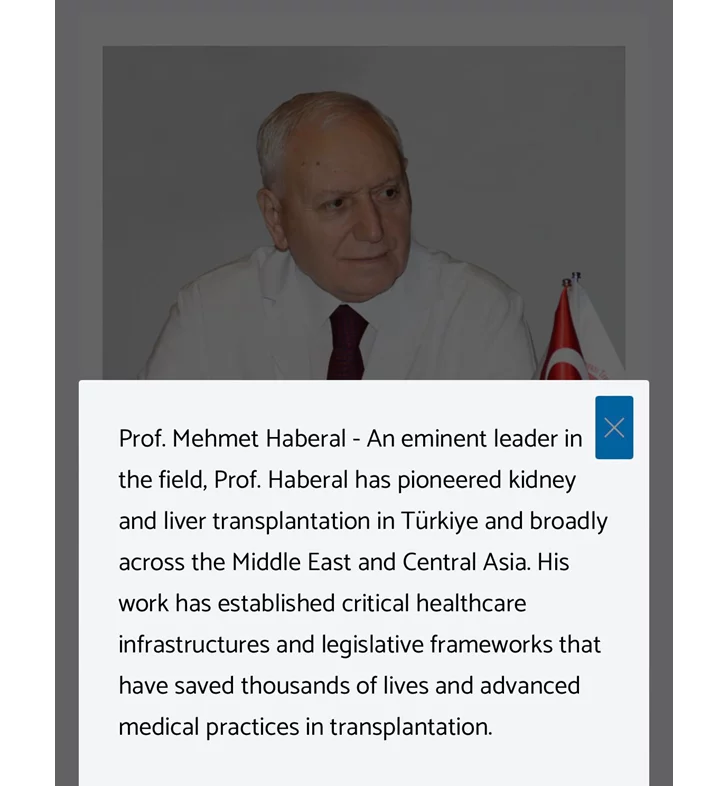
Prof.Dr.Mehmet
Haberal
Abstract
The cornerstone events
of kidney and liver transplant history in Turkey are summarized herein. In
1975, we performed the first pediatric living-related renal transplant in
Turkey. We followed this in 1978 with the first deceased donor kidney
transplant, using an organ supplied by Euro transplant. In 1979 the law on harvesting,
storage, grafting, and transplant of organs
and tissues was
enacted; the first local deceased donor kidney transplant was performed by our
team in 1979. In 1988, another ground-breaking event in Turkey, the Middle
East, and North Africa was successfully achieved: the first successful deceased-donor
liver transplant, and in 1990, the first pediatric living-related segmental
liver transplant in Turkey, the region and Europe was performed by our team.
One month later, an adult-to-adult living-related liver transplant (left lobe)
in the World was successfully performed. On May 16, 1992, we performed the
first combined liver-kidney transplant from a living-related donor, which was
the first operation of its kind in the World. Between November 1975 and January
2022, we have performed 3288 kidney (380 pediatric) at the Hacettepe University
Hospitals and later on at Baskent University; since 1988, 701 (334 pediatric)
liver transplants have been performed. In over 40 years of kidney and liver transplants
history in Turkey, 46876 kidney (2502 pediatric patients) and 18203 liver (2612
pediatric patients) transplants have been performed nationwide. In 2001, the
Ministry of Health established the National Coordination Center as an umbrella
organization to promote transplant activities, especially for deceased donor
organ procurement. Transplant activities are accelerating daily throughout the
country, but deceased donors are still far below the desired rates.
Introduction
Organ
transplant for children remains one of the most complex and challenging areas
within current medical practice. The practice of transplant in the pediatric
population has revolutionized the life of children with end-stage organ failure.
Pediatric transplant as a subspecialty is growing around the world with the
establishment of new transplant programs and prioritization of organs for
children. In 1953, the first temporarily successful transplant of a human
kidney was performed by Jean Hamburger in Paris. A 16-year-old boy received the
kidney of his mother as living donor transplant.1 Then in 1954, a milestone was
made with the first long-term successful kidney transplant by Joseph Murray.
Joseph Murray, a plastic surgeon, performed the first successful kidney transplant
on the Herrick brothers, adult identical twins.2 In February 1967, 6-year-old
Tommy Hoag became the first Children’s Hospital Los Angeles (CHLA) patient to
undergo a kidney transplant with a kidney donated by his father.
History
of Pediatric Kidney Transplant in Turkey
A first
attempt of a solid-organ transplant in Turkey began with two heart transplants
in 1968. By the early 1970s, we started to conduct experimental studies on
livertransplant and on November 3, 1975, we performed thefirst pediatric
renal transplant in Turkey, with a kidney donated from mother to her
12-year-old son . In an attempt to start a deceased-donor program in
Turkey, I contacted and worked in cooperation with international networks,
including first the Eurotransplant Foundation (Leiden, The Netherlands) and
then the South Eastern Organ Procurement Foundation (Richmond, VA, USA). Thus, we
were able to perform the first deceaseddonor kidney transplant, which
was carried out at our center on October 10, 1978, using an organ
supplied by the Eurotransplant Foundation.
Kidneys
donated by these organizations were used with a high success rate even though
they were anatomically problematic. Following these successful imported kidney transplants,
we increased the cold ischemia time from 12 hours to more than 100
hours. It became apparent that it would be necessary to have legislation to
govern transplant activities; as a result of our efforts, the law on
harvesting, storage, grafting, and transplant of organs and tissues was enacted
on June 3, 1979. Later that year on July 27, 1979, we performed the
first local deceased-donor kidney transplant. We also worked with the
Turkish public to provide education about the benefits of and social
responsibilities involved in organ donation. In addition, we founded The Turkish
Organ Transplant and Burn Treatment Foundation in 1980 to advance these
interests. Standardized “Organ Donation Cards” were printed as well, with the
aim to promote donation and bring this concept to life in peoples’ minds. On
January 21, 1982, some new articles were added to Law 2238, with the enactment
of Law 2594, which
allowed
for deceased donation without consent from next of-kin. We started performing
liver transplants right after this.
History
of Pediatric Liver Transplantation in Turkey
In 1963,
Thomas Starzl undertook the world’s first human liver transplant. The recipient
was a 3-year-old boy and the donor was another child. Unfortunately, the
pediatric patient died intraoperatively. Four years later, in 1967, Starzl
performed the first successful liver transplant, for a 19-month old girl with
hepatoblastoma who was able to survive for over 1 year.8 This was followed by a
period of many ground-breaking events; on December 8, 1988, we performed the
first successful deceased liver transplant in Turkey and the region
. In 1989, Raia and his associates reported the first 2 pediatric
transplants using grafts taken from living donors in Brazil, but both
recipients died of medical complications. Following this, Dr. Broelsch and
associates were able to perfom living related liver transplant in Chicago.9,10 At
the same time, I started experimental studies on sheep. This was followed by
the first pediatric (1-year-old child) living-related segmental liver
transplant in Turkey, the Middle East, and Europe on March 15, 1990 ; just 1
month later, we achieved success with the first adult living related liver
transplant (left lobe) in the world, after grafting tissue from a father to his
22-year old son . In addition, we conducted heterotopic liver transplants. In
1998, we performed a heterotopic deceased-donor partial liver transplant to a
17-year-old girl, heterotopic living-related transplant to a 16-yearold boy,
and a heterotopic living-related liver transplant to a 17-year-old boy from his
mother in 1999.12-20 These were followed by other heterotopic liver transplants
either from deceased or living related donors in the following years . On May
16, 1992, we performed the first combined liver-kidney transplant from a
living-related donor, which was the first operation of its kind anywhere in the
world .
Conclusions
In 2001,
the Ministry of Health established the National Coordination Center as an
umbrella organization to
promote
transplant activities, especially for deceased donor organ procurement.
Transplant activities are accelerating day by day throughout the country, but deceased
donors are still far below the desired rates. Efforts to increase awareness
continue through the media, schools, and many public and private institutions.
Improvements in legislation, education, and coordination are key factors for
increasing the quality and the quantity of transplant activities in Turkey. Since
3 November 1975 until 1 January 2022, our team has performed 3288 kidney
transplants (380 pediatric and 2908 adult patients), and since 1988, 701
liver transplants (334 pediatric and 367 adult patients). In over 40
years of kidney and liver transplant history
in
Turkey, 46876 (2502 pediatric patients) kidney and 18203 (2612 pediatric
patients) liver transplants have been performed nationwide. In
conclusion, transplant is currently the best option
for
children with chronic organ failure. Although pediatric organ transplant is
active in some parts of many developing countries, it is still inactive in many
others and mostly relying on living donors. The lack of deceased donor programs
in most of these countries is one of the main issues to be addressed to
adequately respond to organ shortages. Still, pediatric kidney transplant
outcomes are markedly improved and younger children today experience better
long-term graft survival and anticipate even more advances in the future of
pediatric kidney transplant.
References
1.
Hatzinger M, Stastny M, Grutzmacher P, Sohn M. The history of
kidney
transplantation. Urologe A. 2016;55(10):1353-1359. [Article
in
German] doi: 10.1007/s00120-016-0205-3.
2.
Verghese PS. Pediatric kidney transplantation: a historical review.
Pediatr Res. 2017;81(1-2):259-264. doi: 10.1038/pr.2016.20
3.
https://www.childrenshospitals.org/Newsroom/Childrens-Hospitals-
Today/Issue-Archive/Issues/Fall-2017/Articles/One-of-the-
First-Pediatric-Kidney-Transplant-Patients-Still-Going-Strong
4.
Haberal M, Buyukpamukcu N, Saatci U, et al. Kidney transplantation.
In:
Abstracts of the 1st National Dialysis and Transplant
Meeting
of Turkey. Bursa, Turkey, June 4–6, 1980. Kidney
International.
1981;19(1):103
-105.
5.
Haberal M, Gulay H, Arslan G, Bilgin N. Cadaver kidney transplantation
with
prolonged cold ischemia time. Transplant
Proc.
1988;20(1
Suppl 1):932-934.
6.
Haberal M, Aybasti N, Arslan G, Bilgin N. Cadaver kidney transplantation
cases
with a cold ischemia time of more than 100
hours. Clin Transpl. 1986;126-127.
7.
Haberal M, Demirag A, Cohen B, et al. Cadaver kidney transplantation
in
Turkey. Transplant Proc. 1995;
27(5):2768-2769.
8.
Justin Barr, J. Andrew Bradley, David Hamilton. Organ transplantation:
A
historical perspective. In: Hakim N, Haberal M, Maluf D,
eds. Transplantation Surgery.
Springer Specialist Series; 2021:1-29.
9. Raia
S, Nery JR, Mies S. Liver transplantation from live donors.
Lancet. 1989;2(8661):497.
10.
Broelsch CE, Whitington PF, Emond JC, et al. Liver transplantation
in
children from living related donors. Surgical techniques and
results.
Ann Surg. 1991; 214(4):428-437; discussion 437-439.
11.
Haberal M, Buyukpamukcu N, Telatar H, et al. Segmental living
liver
transplantation in children and adults. Transplant
Proc.
1992;24(6):2687-2689.
12.
Haberal M. The technique of partial auxiliary heterotopic liver
transplantation
in dogs. Hacettepe Tıp/Cerrahi
Bülteni.
1980;13(1):1-11.
13.
Haberal M, Moray G, Bilgin N, et al. A preliminary report on
heterotopic
segmental living-related and/or split-liver cadaver
transplantation.
Transplant Proc. 1999;31:2899-2901.
14.
Haberal M, Karakayali H, Boyacioglu S, et al. Successful living-related
heterotopic
auxiliary liver transplantation for chronic Budd-
Chiari
syndrome. Transplant Proc. 1999;31:2902-2903.
15.
Haberal M, Arda IS, Karakayali H, et al. Heterotopic segmental
liver
transplantation in children. Transplant
Proc. 2000;32:535-
536.
doi: 10.1016/s0041-1345(00)00878-2
16.
Haberal M, Arda IS, Karakayali H et al. Successful heterotopic
segmental
liver transplantation from a live donor to a patient
with
Alagille syndrome. J Pediatr Surg. 2001;36(4):667-671.
doi:
10.1053/jpsu.2001.22317
17.
Haberal M, Karakayali H, Emiroglu S, et al. Heterotopic liver transplantation
during
adolescence. Transplant Proc. 2001;33:2832-
2833.
18.
Haberal M, Emiroglu R, Arslan G, Karakayalı H, Moray G, Bilgin N.
Long-term
survival with heterotopic liver transplantation. Transplant
Proc. 2002;34:2468-2471.
19.
Boyvat F, Aytekin C, Firat A, Harman A, Karakayali H, Haberal M.
Diagnostic
and therapeutic management of hepatic artery
thrombosis
and stenosis after orthotopic and heterotopic liver
transplantation.
Transplant Proc. 2003;35:2791-2795.
20.
Haberal M, Sevmis S, Karakayali H, Ozcay F, Moray G, Arslan G.
Long-term
survival in a patient after heterotopic segmental auxiliary
liver
transplantation. Pediatr Transplant.
2008;12(7):816-820.
doi:10.1111/j.1399-3046.2007.00823.x.
21.
Haberal M, Abbasoğlu N, Buyukpamukcu N, et al. Combined liver-
kidney
transplantation from a living related donor. Transplant
Proc. 1993;25(3):2211-2213.
22.
Margreiter R, Kramar R, Huber C, et al. Combined liver and kidney
transplantation.
Lancet. 1984;1(8385):1077-1078. doi:10.1016/
s0140-6736(84)91486-7