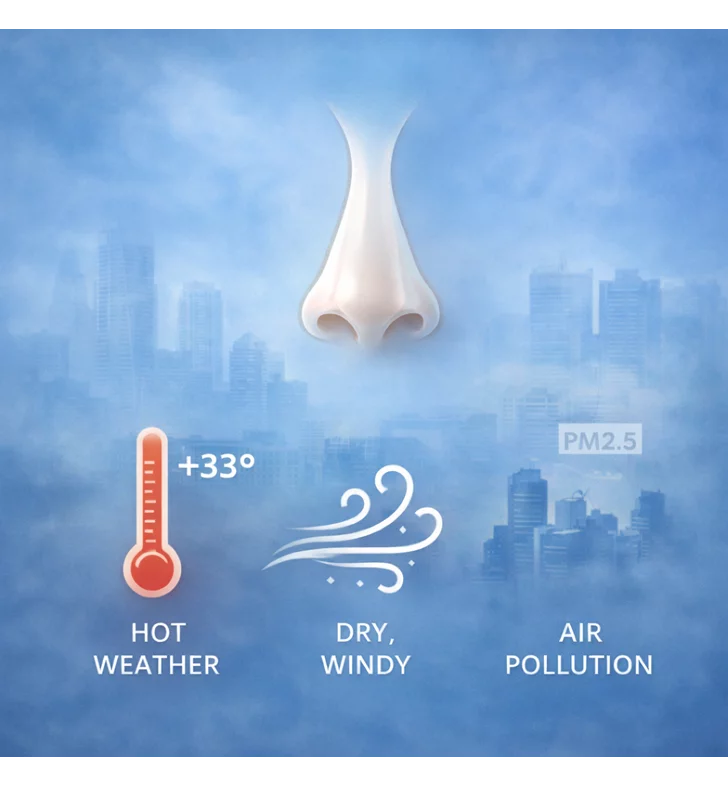
The role of meteorologic factors and air pollution on the frequency of pediatric epistaxis
The role
of meteorologic factors and air pollution on the frequency of pediatric epistaxis
M.
Volkan Akdoğan, MD; Evren Hızal, MD; Mustafa Semiz, PhD; Özgül
Topal, MD;Hakan Akkaş, MD; Aydın Kabataş, MSc; Selim S. Erbek, MD
Abstract
Fluctuations in atmospheric temperature,
humidity,and air pollution are associated with the incidenceof epistaxis. To
date, no study in the literature hasevaluated the effect of air pollution and
meteorologicconditions on the pediatric population. We aimed toevaluate the
effect of meteorologic factors and air pollu-tion on the frequency of epistaxis
in children. Childrenpresenting to an outpatient clinical setting at a
tertiarycare hospital during a 5-year period (July 1, 2009, toJune 30, 2014)
and diagnosed with epistaxis formedthe study population. Daily temperature and
humidityparameters and average daily atmospheric water va-por pressure, average
daily concentration of particulatematter <10 µm in diameter, and sulfur
dioxide read-ings were obtained. The distribution of daily parame-ters was
analyzed. Of the 1,559 children with the pri-mary diagnosis of epistaxis, data
from 1,330 childrenwere analyzed after excluding patients with
coexistingpathologies. Positive correlations were found betweenthe frequency of
epistaxis and both the average dailytemperature and the difference between the
maximumand minimum daily temperature. There was a negativecorrelation between
the epistaxis frequency and the av-erage daily humidity, the difference between
the maxi-mum and minimum daily humidity, the average dailyconcentration of
particulate matter, and the sulfur di-oxide levels. Our findings suggest that
epistaxis in chil-dren is related to high temperatures and low humidity.
IntroductionEpistaxis is common in children.
Thirty percent ofchildren younger than 5 years, 56% of those 6 to 10years old,
and 64% aged 11 to 15 years have at least onenosebleed attack.1Epistaxis is
classified as anterior or posterior basedon the primary bleeding site. Most
childhood epistaxisis spontaneous anterior and self-limiting in nature.2 Inmost
children, epistaxis originates from the Little area,which is located at the
anterior region of the nasal sep-tum, where several terminal vessels anastomose
witheach other forming a plexus (Kiesselbach plexus) underthe nasal
mucosa.3Atmospheric conditions may be linked with the ratesof epistaxis.
Fluctuations in temperature and humidityare associated with nasal mucosal
changes in the Littlearea and are known to affect the incidence of
epistax-is.3,4 Most studies in the literature suggest that epistaxisoccurs more
frequently in the winter months becauseof an increased prevalence of upper
respiratory tractinfections and mucosal dryness caused by low humidity.Low atmospheric
temperature has been linked withincreased rates of epistaxis in some recent
studies,4-11whereas other reports suggest a relationship with
hightemperature.12,13 Bray et al reported no meteorologicfactors or seasonal
preponderance of epistaxis.14Patient groups in these previous studies
consistedof adult or mixed populations of adult and pediatricpatients.
Epistaxis in adults, however, is considered adifferent condition than epistaxis
in children, with anti-coagulant use and hypertension being common factorsin
adults. Further, posterior epistaxis is more commonin adults than in
children.15Air pollution has significant negative effects on health.Exposure to
high concentrations of pollutants may re-sult in an increased frequency of
epistaxis. Only a fewstudies in the literature have investigated the effect
ofatmospheric pollutant concentrations on the frequencyof epistaxis.16,17 Air
pollution shows seasonal variationsand is associated with meteorologic factors.
The effect of air pollution on rates of epistaxis may be due to a directeffect
of pollutants on the nasal mucosa or a secondaryeffect that is mediated by
other factors such as an increasein blood pressure.16To our knowledge, no study
in the literature hasevaluated the effect of air pollution and meteorologicconditions
on the incidence of epistaxis in the pediatricpopulation. Thus, we aimed to
evaluate the effect of me-teorologic conditions and air pollution on the
frequencyof epistaxis in children Patients and methodsEthical considerations.
This study was approved byBaskent University Institutional Review Board
(Proj-ect no: KA 15/240) and supported by Baskent Univer-sity Research
Fund.Study design. The patient files of children <16 yearsold who were seen
in an outpatient clinic setting ata tertiary care hospital during a 5-year
period (July1, 2009, to June 30, 2014) and diagnosed as epistaxiswith the R04.0
code according to The InternationalClassification of Diseases, 10th Revision
(ICD-10), wereretrospectively reviewed.R04.0 was the primary diagnosis code for
all patients.Cases of postoperative epistaxis and patients with majornasal
trauma, intranasal mass, or foreign body were ex-cluded. In addition, patients
who had a bleeding disorder,systemic disease such as hepatic or renal
insufficiency,hereditary hemorrhagic telangiectasia, and those whohad a history
of anticoagulant or antiplatelet drug usewere excluded from the study.The
meteorologic data were provided by the TurkishState Meteorological Service. Air
pollution parameterswere obtained from the Konya Metropolitan Munic-ipality
website (http://www.konya.bel.tr/havakalitesi.php). Average daily temperature
(TAV)(0C), daily max-imum (TMAX) and minimum (TMIN) temperature (0C),the
difference between the maximum and minimum daily temperature (TDIF)(0C), average
dai-ly relative humidity (HUMAV)(%), dailymaximum (HUMMAX) and minimum(HUMMIN)
humidity (%), the differencebetween the maximum and minimumdaily relative
humidity (HUMDIF)(%),average daily atmospheric pressure (PATM)(hPa), average
daily atmospheric watervapor pressure (PWV)(hPa), average dailyconcentration of
particulate matter <10µm in diameter (PM10)(µm/m3), and sul-fur dioxide
(SO2)(µm/m3) readings wereobtained for 1,826 days (between July 1,2009, and
June 30, 2014).Seasonal and monthly distributionsof daily parameters were
analyzed. For seasonal distribution, each year was divided into
fourconventional seasons as summer (June 1 to August31), autumn (September 1 to
November 30), winter(December 1 to February 28/29), and spring (March1 to May
31).Statistical analysis. All analyses were performedusing the Statistical
Package for the Social Sciences forWindows version 15.0. Mean and standard
deviationwere used for continuous variables and frequency, andpercentages were
used for categorical variables explain-ing descriptive statistics. The
K-dependent Friedmantest was used for monthly and seasonal comparison
ofparameters. The Pearson correlation coefficient wasused for detecting the
relationship between parameters,and the Spearman correlation coefficient was
usedfor detecting the relationship between the SO2 levelsand other parameters.
For graphics, all values werenormalized and standardized. A p value of <0.05
wasconsidered statistically significant. ResultsA total of 1,559 patients had a
primary diagnosis of ep-istaxis. After patients with coexisting pathologies
wereexcluded, 1,330 subjects remained. The mean age ofthe patients was 92.5 ±
44.62 months (range: 9 to 192months). A total of 782 patients (58.8%) were boys
and548 (41.2%) were girls.Standardized and normalized frequency of cases
andmonthly temperature parameters during the 5-year studyperiod are shown in
figure 1. July had the highest dailyadmission frequency (1.45/day) followed by
August(1.28/day), September (0.99/day), and June (0.96/day).Lowest daily
admission frequency was obtained inNovember (0.47/day), February (0.45/day),
December(0.4/day), and January (0.38/day).The coldest month of the year was
January, with amean daily temperature of 2.56°C, followed by December(3.67°C),
February (4.12°C), and March (7.8°C). The hottest month was July, with a mean
daily temperatureof 25.39°C, followed by August (24.52°C), June (21.5°C),and
September (20.34°C).Lowest monthly relative humidity was in August(33.13%),
followed by July (35.87%), September(39.48%), and June (46.87%). The
presentation rates werealso highest in these months. Relative humidity was
thehighest in January (78.19%), December (75%), Novem-ber (68.19%), and
February (65.51%). The relationshipbetween the humidity parameters and presentation
ratesis shown in figure 2.The standardized values of atmospheric pressure
andwater vapor pressure parameters and frequency of epi-staxis are shown in
figure 3. Atmospheric pressure washigher in winter months, whereas water vapor
pressurewas higher in summer months.Air pollution values were higher for the
winter andlower for the summer months. The relationship between the air
pollution parameters and frequencyof epistaxis is shown in figure 4.A positive
correlation was observedbetween the frequency of epistaxis andboth the average
daily temperature andthe difference between the maximum andminimum daily
temperature. The correla-tion was negative between the epistaxisfrequency and
the average daily humidity,the difference between the maximum andminimum daily
humidity, PM10, and SO2levels (p < 0.05).When the mean daily temperature
wasdivided into 10°C bands and average dailyrelative humidity was divided into
20%bands, the frequency of epistaxis was foundto increase with low humidity and
hightemperature (figures 5 and 6). In terms of all variables calculated,
statistical analysisrevealed a significant difference in epistaxisfrequency
between the seasons (p < 0.01),with the incidence being highest in sum-mer
and lowest in winter. In the summerseason, the average daily temperature andthe
difference between the maximum andminimum temperature was the highest,and the
daily humidity and the differencebetween the maximum and minimumhumidity was
lowest. DiscussionEpistaxis appears to have a bimodal agedistribution. The peak
ages of incidenceare <18 years and >50 years. Nosebleedstend to be more
severe in the older popu-lation, whereas those in children and ad-olescents are
more often minor and self-limited.18In adults, various underlying conditions
such asallergic rhinitis, chronic sinusitis, coagulopathy, al-cohol abuse,
substance abuse, antihemostatic agentuse (anticoagulant and/or antiplatelet
medications),renal diseases, hereditary hemorrhagic telengiectasia,hematologic
malignancies, and cardiovascular diseasesincluding hypertension and congestive
heart failure areassociated with the incidence of epistaxis.4,18 Meteoro-logic
factors and air pollution may not only affect theincidence of epistaxis but
also are associated with at leastsome of those comorbidities such as hypertension.19,20The
incidence of the comorbidities that are associatedwith epistaxis also increases
with age. Thus, it is difficultto distinguish the real effect of atmospheric
conditionson epistaxis in a population that consists of both childrenand adults.
Etiologic factors in pediatric epistaxis arenot clearly understood. To our
knowledge, the effect of atmospheric conditions and air pollution on
childhoodepistaxis has not been adequately studied.In our study, we analyzed
all patients presentingwith epistaxis and excluded patients with
coexistingpathologies. Our study population consisted exclusivelyof pediatric
patients. Epistaxis is often bothersome andalarming for both parents and
children so that parentsmay be more sensitive in seeking medical care, andtherefore
the presentation rates may differ from thoseof adults. Childhood may be the
more appropriate time to inves-tigate the effect of atmospheric conditions on
epistaxis,since most of the coexisting risk factors for epistaxisin adults that
may also be affected by atmosphericconditions do not exist in children.
Moreover, childrenare physiologically and metabolically less effective
atadapting to changes in ambient humidity and otherweather-related exposures
and are more sensitive toclimate changes compared with adults..21Results of the
studies in the literature have shownvariable effects of climatic conditions on
the frequencyof epistaxis. Sowerby et al found a negative correlationbetween
the rate of epistaxis and temperature and nocorrelation between the epistaxis
rate and humidityin a cold climate.5 Muhammad et al found that lowtemperature
and humidity increase the incidence ofepistaxis in a climate that has mostly
rainy seasons. 6 In a climate similar to that of our region, Kemal and
Sendetermined a positive correlation between the rates of epi-staxis and
temperature, and a negative correlation betweenrates of epistaxis and humidity,
air pressure, and rainfall.13Other studies have not found a correlation between
theambient temperature and epistaxis presentation rate.14Increased incidence of
upper respiratory tract infections inwinter months has been suggested as the
underlying reasonfor increased epistaxis admissions during the winter.7
In our study, the difference between the
maximum andminimum daily temperatures was highest in summer(12.77°C) and lowest
in winter (8.1°C). Adaptation ofnasal mucosa to fluctuations in daily
temperature mightlead to nasal dryness and crusting in children and
maypredispose to bleeding.Particulate matter (PM) is the term for a complexmixture
of organic and inorganic solid particles andliquid droplets found in the air.
Particles <10 μm canpenetrate farther into the lung and are considered
moreirritant. SO2 is typically produced from the burning ofcoal and other
sulfur-containing fossil fuels. Gasolineand diesel motor vehicles produce
carbon monoxide(CO), nitrogen dioxide (NO2), and PM. Ozone (O3)is produced as a
byproduct of these pollutants and isconsidered a long-range pollutant that is
highly irritantto respiratory epithelium.17,22We found a negative correlation
between rates ofepistaxis and PM10 and SO2 levels. One possibility forthe
negative correlation may be that PM10 and SO2 levelsalone are not completely
representative of air pollution.Another explanation may be that the duration
and levelof exposure to these air pollutants in chil-dren is not high.
Meteorologic conditionscan alter the intensity and the effects of airpollution.
Bray et al and Zemek et al re-ported that the level of O3, which is
anotherindicator of air pollution, is higher duringsummer, whereas the levels
of most pol-lutants increase during cold weathers.17,22O3 levels are often
higher in warmerweather because heat and sunlight increaseO3 formation.
Children are at higher riskfrom O3 exposure because they spend moretime
outdoors in warmer weather.23 O3 lev-els were not routinely measured in
Konya,where our institution is located. However,a passive sampling method can
infer the O3levels, which measured higher in summerthan in winter for a 15-day
period.2 Szyszkowicz et al found that high PM10 and O3 levelsincreased the risk
of epistaxis, and the associationbetween the epistaxis and the air pollution
levels wasstronger in older individuals and in women.16 Brayet al also detected
a relationship between PM10 andO3 levels and epistaxis, with no association
foundbetween NO2, CO, and SO2 levels and the frequencyof epistaxis.17 Positive
correlation between the airpollution and the epistaxis rates as shown in
thosestudies may be the result of an indirect effect ofair pollution on blood
pressure and coagulationparameters.16,25Our findings suggest that the frequency
of epistaxisin children is greater in the summer and with low hu-midity. The
incidence of posterior epistaxis or epistaxisassociated with systemic
conditions might be differentor not show a seasonal variation pattern. High
rates ofepistaxis in the winter, as reported in the literature,might be a
result of coexisting risk factors other thanthe low temperature or air
pollution alone. Culturaland traditional factors and factors not directly
relatedto atmospheric conditions, such as digital trauma,Staphylococcus aureus
colonization, or undeterminedcoexisting pathologies also may vary in
differentpopulations and therefore may affect the frequency ofepistaxis in
children.
Conclusion
Atmospheric
conditions and air pollution affect thefrequency of epistaxis in children.
Multicentric, popu-lation-based prospective studies covering different
cli-matic conditions are needed to detect the exact effectof environmental
factors on epistaxis rates.
References
1.
Pertuson B. Epistaxis in childhood. Rhinology 1979;17(2):83-90.
2.
Davies K, Batra K, Mehanna R, Keogh I. Pediatric epistaxis:epidemiology,
management & impact on quality of life. Int JPediatr Otorhinolaryngol
2014;78(8):1294-7.
3.
Qureishi A, Burton MJ. Interventions for recurrent idiopathicepistaxis
(nosebleeds) in children. Cochrane Database Syst Rev2012;9:CD004461.
4.
Purkey MR, Seeskin Z, Chandra R. Seasonal variation andpredictors of epistaxis.
Laryngoscope 2014;124(9):2028-33.
5.
Sowerby LJ, DeSerres JJ, Rudmik L, Wright ED. Role of season,temperature and
humidity on the incidence of epistaxis inAlberta, Canada. J Otolaryngol Head
Neck Surg 2014;43:10.
6.
Muhammad R, Khan F, ul Abrar S, et al. Effect of temperatureand humidity on
epistaxis in Hazara division. J Ayub Med CollAbbottabad 2013;25(3-4):61-3.
7. Reddy
VM, Judd O, Khalil H. Investigation of the influence ofambient temperature,
atmospheric pressure and water vapourpressure on epistaxis admission rate.
Rhinology 2010;48(3):348-51.
8.
Walker TW, Macfarlane TV, McGarry GW. The epidemiology andchronobiology of
epistaxis: An investigation of Scottish hospitaladmissions 1995-2004. Clin
Otolaryngol 2007;32(5):361-5.
9.
Danielides V, Kontogiannis N, Bartzokas A, et al. The influenceofmeteorological
factors on the frequency of epistaxis. ClinOtolaryngol Allied Sci
2002;27(2):84-8.
10.
Tomkinson A, Bremmer-Smith A, Craven C, Roblin DG.Hospital epistaxis admission
rate and ambient temperature. ClinOtolaryngol Allied Sci 1995;20(3):239-40.
11.
Nunez DA, McClymont LG, Evans RA. Epistaxis: A study ofthe relationship with
weather. Clin Otolaryngol Allied Sci1990;15(1):49-51.
12.
Murata S, Maesaka A, Miyazaki T, et al. Statistical analysis ofepistaxis. Nihon
Jibiinkoka Gakkai Kaiho 1978;81(7):655-64.
13.
Kemal O, Sen E. Does the weather really affect epistaxis?
B-ENT2014;10(3):199-202.
14. Bray
D, Giddings CE, Monnery P, et al. Epistaxis: Are temperatureand seasonal
variations true factors in incidence? J Laryngol Otol2005;119(9):724-6.
15.
Kubba H. Childhood epistaxis. Clin Otolaryngol 2006;31(3):212-3.
16.
Szyszkowicz M, Shutt R, Kousha T, Rowe BH. Air pollution andemergency
department visits for epistaxis. Clin Otolaryngol2014;39(6):345-51.
17. Bray
D, Monnery P, Toma AG. Airborne environmental pollutantconcentration and
hospital epistaxis presentation: A 5-yearreview. Clin Otolaryngol Allied Sci
2004;29(6):655-8.
18.
Manes RP. Evaluating and managing the patient with nosebleeds.Med Clin North Am
2010;94(5):903-12.
19.
Brennan PJ, Greenberg G, Miall WE, Thompson SG. Seasonalvariation in arterial
blood pressure. Br Med J (Clin Res Ed)1982;285(6346):919-23.
20. de
Paula Santos U, Braga AL, Giorgi DM, et al. Effects of airpollution on blood
pressure and heart rate variability: A panelstudy of vehicular traffic
controllers in the city of São Paulo,Brazil. Eur Heart J 2005;26(2):193-200.
21. Gao
J, Sun Y, Lu Y, Li L. Impact of ambient humidity on childhealth: A systematic
review. PLoS One 2014;9(12):e112508.
22.
Zemek R, Szyszkowicz M, Rowe BH. Air pollution and emergencydepartment visits
for otitis media: A case-crossover study inEdmonton, Canada. Environ Health
Perspect 2010;118(11):1631-6.
23.
United States Environmental Protection Agency. Air Quality Index:A guide to air
quality and your health. http://www.airnow.gov/index.cfm?action=aqi_brochure.index.
Accessed July 7, 2018.
24.
Republic of Turkey Ministry of Environment and UrbanPlanning. Konya Clean Air
Action Plan (2013-2019).(KonyaTemiz Hava Eylem Plani 2013-2019).
https://docplayer.biz.tr/9238070-Konya-temiz-hava-eylem-plani-2013-2019.html.Accessed
July 7, 2018.
25.
Seaton A, MacNee W, Donaldson K, Godden K. Particulate airpollution and acute
health effects. Lancet 1995;345(8943):176-8.